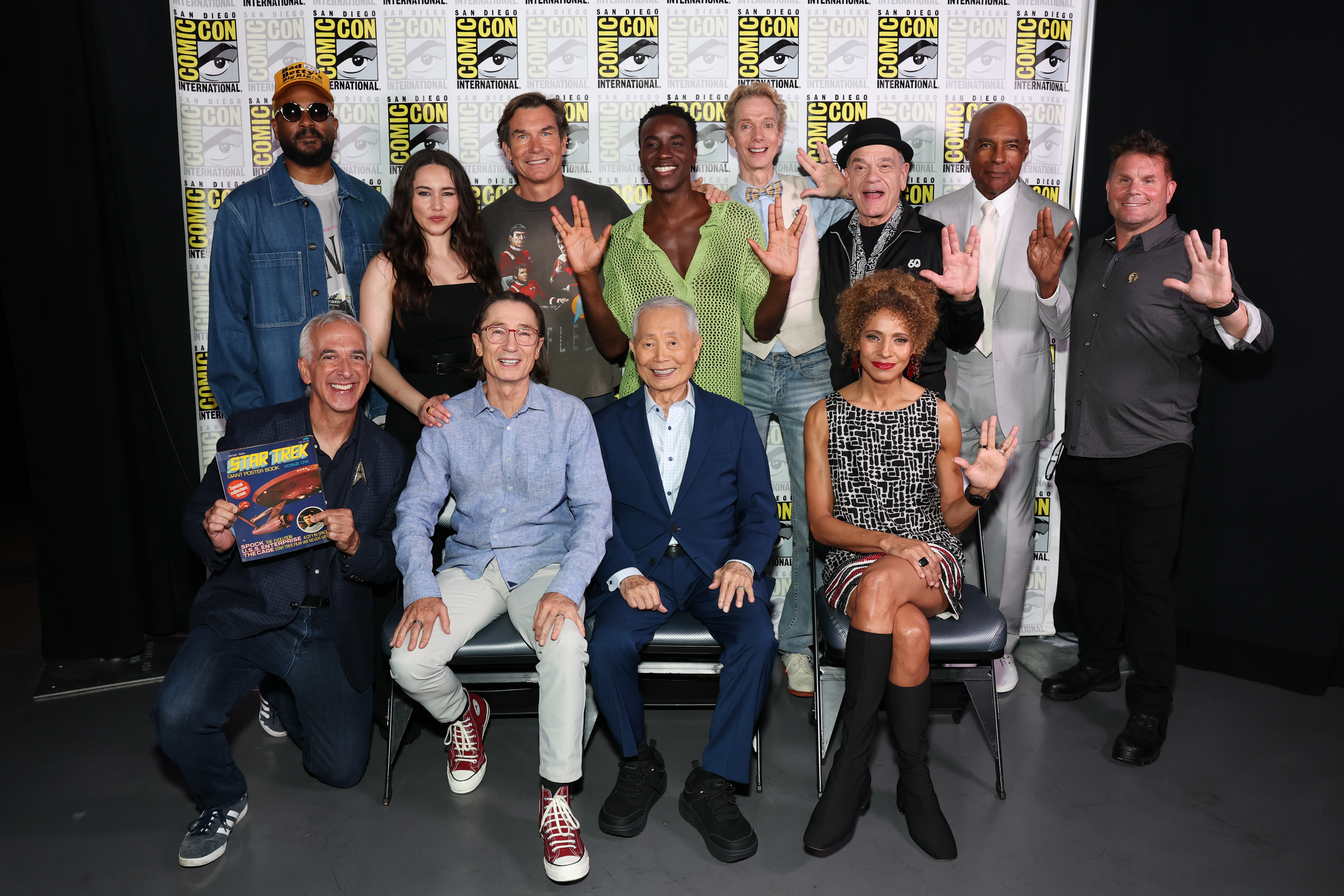
Star Trek at 60: George Takei and the Franchise’s Stars Reflect on a Legacy of Hope, Diversity and Going Where No One Has Gone Before

Sixty years after Star Trek first transported audiences aboard the USS Enterprise, the franchise returned to San Diego Comic-Con with generations of stars coming together to celebrate a legacy that has become much bigger than television.
Table Of Content
The Star Trek 60th Anniversary celebration in Hall H brought together talent from across the franchise, including George Takei, Michael Dorn, Doug Jones, Jerry O’Connell, Robert Picardo, Michelle Hurd, and more. The anniversary celebration followed the Star Trek: Strange New Worlds presentation and served as a reminder that, six decades later, the franchise continues to connect generations of fans.
But sitting down with the stars at SDCC, it quickly became clear that the lasting power of Star Trek isn’t simply about spaceships, aliens or exploring the final frontier. For many of the people who have been part of the franchise, it is about what that future represents.
RELATED: Simon Pegg Thinks Star Trek 4 Will Only Happen After a “Terrible” Reboot
And perhaps no one could speak to that more personally than George Takei.
George Takei on the Meaning of Star Trek
Takei, who played Hikaru Sulu in the original series, reflected on the message Gene Roddenberry built into Star Trek: IDIC — Infinite Diversity in Infinite Combinations.
For Takei, the message is deeply personal.
As a Japanese American child, Takei was imprisoned with his family during World War II simply because of his ancestry. During our conversation, he recalled watching soldiers arrive at his family’s home and order them to leave.
“I was five years old,” Takei recalled, describing the experience as something permanently embedded in his memory.
That history would later give even greater meaning to his place aboard the Enterprise.
“Gene Roddenberry created Star Trek with a vision of our future,” Takei explained. “His hope was that the future was that we would learn from that difficult history, and learn to see the differences as something that we can learn from rather than hate.”
That idea was revolutionary when the original series premiered in 1966, placing people from dramatically different backgrounds together on the bridge of the Enterprise.
Takei pointed to the show’s groundbreaking casting, including Nichelle Nichols as communications officer Uhura and Walter Koenig as the Russian-born Pavel Chekov, as evidence of Roddenberry’s belief that humanity could eventually overcome the divisions of its own time.
“It was a very optimistic, hopeful view of our future,” Takei said.
But Takei also made it clear that the work isn’t finished.
“We have learned from our historic differences, but not learned that lesson enough to be able to live without killing, fighting, lack of understanding and killing each other,” he said.
That tension between the future Star Trek imagined and the world we actually live in remains one of the franchise’s most powerful ideas.
RELATED: Star Trek Universe Panel at San Diego Comic Con
More Than a Television Show
For the newer generations of Star Trek talent, being part of the franchise comes with an awareness that they’re participating in something much larger than a normal television job.
Jerry O’Connell, who voices Captain Jack Ransom on Star Trek: Lower Decks, admitted that the significance of the 60th anniversary didn’t fully hit him until he arrived in San Diego.
“When you’re on that panel with Mr. Takei, you realize this is bigger than a gig,” O’Connell said. “It’s bigger than being on a show. It’s bigger than entertainment history. It’s not TV history. It’s like history, history.”
O’Connell’s wife, Rebecca Romijn, is also part of the Star Trek universe through Strange New Worlds, giving the franchise an extra connection inside their own home.
He joked that he technically outranks his wife in the Starfleet hierarchy.
“I do outrank my wife in the Starfleet world,” O’Connell joked, before admitting that it probably wasn’t something he should remind her of too often.
But underneath the humor was genuine appreciation for being welcomed into the Star Trek family.
“You’re just part of a family,” he said.
Doug Jones Finds Hope in Saru
Doug Jones, who played Saru on Star Trek: Discovery, also spoke about what the franchise means beyond science fiction.
Saru’s journey was particularly meaningful because he wasn’t simply another alien character. Over the course of the series, audiences watched him evolve from a fearful Kelpien into a Starfleet captain and eventually an ambassador.
Jones described Saru as an “onion with peels,” with more of his history and personality revealed throughout the series.
“I think that just gives people hope that no matter who you are, where you come from, there is an ascension for you somewhere out there,” Jones said.
For Jones, that is one of the reasons Star Trek has survived for six decades.
“I think is because people do find hope in all things Star Trek,” he said. “We see a future where there is conflict that can be solved with diplomacy.”
That idea feels particularly important when looking at the franchise’s original mission. Star Trek has always imagined a future where differences don’t automatically have to lead to destruction.
Representation Still Matters
The franchise’s commitment to diversity also continues to resonate with its newer stars.
One of the newer cast members spoke candidly about the intense online response to the representation featured in the series, including racist, homophobic and sexist criticism.
But rather than seeing that backlash as a reason to retreat, the actor viewed it as proof that the show was creating conversations that needed to happen.
“I’m so proud that we did this this way that we started these conversations,” they said. “We have to talk about it until we move forward.”
The response from fans has been even more meaningful.
“I get messages online every day from queer people or from Black people or from women who feel represented by seeing themselves in the show,” the actor explained.
And that representation can have a profound impact.
“If you see yourself on television all the time, you don’t know what it’s like not to see yourself,” they said.
That sentiment gets directly to the heart of IDIC.
Star Trek doesn’t ask audiences to erase their differences. It asks them to imagine what could happen if those differences existed alongside one another rather than being used as reasons to divide.
The Franchise Belongs to the Fans
Throughout the SDCC interviews, another theme kept coming up: the fans.
For a franchise approaching its 60th anniversary, the audience isn’t simply watching from the sidelines. They are a major reason Star Trek continues to exist.
“I think the franchise is owned by the fans,” one of the stars said, emphasizing that without generations of viewers supporting the shows and movies, Star Trek would never have reached this milestone.
Takei echoed that sentiment.
The franchise has survived cancellations, changes in television, new casts, new formats and changing technology because audiences continued to believe in it.
And that relationship between Star Trek and its fans may be the franchise’s greatest achievement.
A Legacy That Continues to Evolve
Rod Roddenberry, son of Star Trek creator Gene Roddenberry, also reflected on the legacy his father left behind.
For him, Star Trek was never simply about predicting the future. His father wanted the technology and characters to feel believable so audiences could actually imagine themselves living in that world.
“My father made sure Star Trek had was believability,” Roddenberry explained, noting that his father’s approach extended beyond futuristic technology to the behavior and motivations of the characters.
His father also understood that the franchise would eventually belong to future generations.
Roddenberry recalled that his father once said he hoped “some young writer” would eventually come along and take Star Trek further than he had.
Six decades later, that has happened again and again.
From The Next Generation and Deep Space Nine to Voyager, Enterprise, Discovery, Picard, Lower Decks, Strange New Worlds and Starfleet Academy, every new iteration has added another layer to the universe.
And that’s perhaps why Star Trek continues to feel so relevant.
It doesn’t have to remain exactly what it was in 1966.
It simply has to remain committed to the idea that the future can be better than the present.
As Takei put it, the lesson of Star Trek is ultimately about learning from history and allowing our differences to bring us together rather than tear us apart.
At 60, Star Trek isn’t just looking back.
It’s still looking forward.