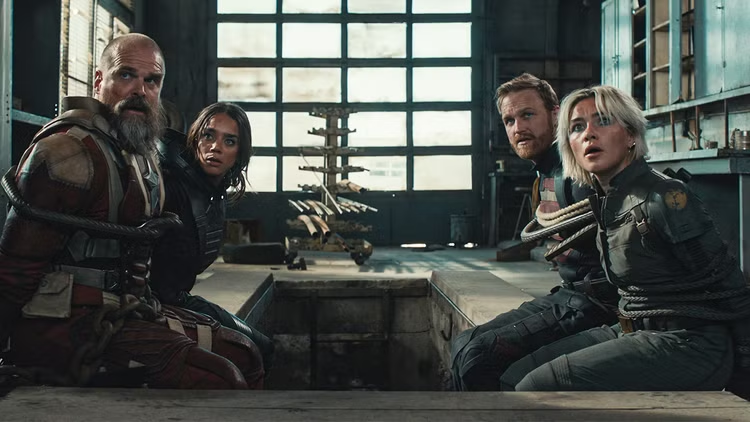

Thunderbolts might just be Marvel’s biggest surprise of the year. And that’s saying a lot—Daredevil: Born Again was peak for me and easily my top pick of the year. I went in with curiosity and left feeling happy, sad, and genuinely unwilling to let go of the experience. I didn’t want to step out of the headspace the film created. This isn’t just a team-up movie—it’s a bold, emotionally rich, and sometimes devastating exploration of trauma, identity, and what it means to try to be better.
From the very first scene, it’s clear that this isn’t going to be a typical Marvel ride. The film opens with a fight that throws us right into the action and into the shifting dynamics of the Thunderbolts team. You immediately understand why the team’s lineup has changed, and although I won’t spoil the reason, I will say this: it’s impactful, it’s messy, and it sets the tone for a story that isn’t afraid to ask difficult questions. These aren’t traditional heroes—they’re survivors, and their wounds are front and center.
RELATED: Avengers: Doomsday Cast Revealed – Full List & Shocking Returns!
The cast delivers. Florence Pugh is once again phenomenal as Yelena Belova, blending strength and vulnerability in a way that grounds every scene she’s in. David Harbour’s Red Guardian, who was more of a comic relief figure in Black Widow, gets real depth here. One of the film’s most emotionally satisfying payoffs is watching him step into the role of a father—truly this time—to Yelena. When she finally calls him “Dad,” it’s earned, and it’s beautiful. A small moment, but one that hits like a freight train.
Sebastian Stan’s Bucky Barnes might have had the weirdest plot twist in Captain America: Brave New World: he’s a congressman. While the how and why are still mysterious, the movie makes it clear that this chapter of Bucky’s life was intentional, even if it’s short-lived. The themes of accountability, healing, and trying to find peace all swirl around his arc. He’s sarcastic, broken, and trying so hard to move forward while carrying the weight of decades of violence. There’s a darkly funny moment where the team’s sharing about their pasts and Bucky deadpans something like, “My time in the Void wasn’t that bad—I’ve had a great past.” It’s hilarious, until you remember what that “great past” actually looked like. That’s the magic of this film: it punches you in the gut when you least expect it.
Then there’s John Walker. Wyatt Russell had a tough job after The Falcon and the Winter Soldier, where Walker was complicated at best, downright infuriating at worst. But here? He gets real depth. You come away liking him—or at least understanding him—and that’s a massive achievement. His internal struggles, the guilt, the feeling of never being enough… it’s all bubbling under the surface. And some of the film’s most unexpectedly human moments come from the characters we least expect. The ones who seem like the biggest jerks end up revealing some of the deepest pain—and most surprising kindness.
RELATED: Exclusive: Ayo Edebiri Reveals Her Dream Superhero Role
And let’s talk about Sentry. Bob Reynolds might just be the best character introduction since Wanda Maximoff. Lewis Pullman plays him with a haunting vulnerability—you want to protect him, even though you know he might be the most dangerous person in the room. His awkwardness, his fear, his desperate need for control—it’s all heartbreakingly real. The way the film handles the duality between Sentry and the Void is masterful. At times, you don’t even know which version you’re seeing on screen. Is this Bob, or is it something darker peeking through? The psychological tension is intense, especially when the Void finally lets loose.
There’s the moment where the Void seemingly takes over New York in a haze of chaos and terror. It’s overwhelming. Right, when the Red Guardian saves a little girl, she is taken out by the Void. The idea that a child could be the first victim is genuinely chilling. But Marvel went there. The shock factor is real, and it proves they’re not afraid to push boundaries in this phase.
What keeps the film from drowning in darkness, though, is the perfectly balanced humor. There are plenty of laugh-out-loud moments that feel natural, not forced. These people have been through hell, and their banter is how they survive. It’s how they connect. And it works. The therapy scenes, the awkward meal conversations, the sarcastic jabs—this group has real chemistry, and you believe they care about each other… even if they suck at showing it.
By the end of the film, the emotional payoff is massive. There’s a group hug scene—yes, a literal group hug—where the team embraces Sentry. It’s tender, raw, and powerful. I cried. Because that moment says everything this movie is about: you are not alone. These characters who were built to destroy, who were cast aside, who were told they were broken… they find healing in each other. And maybe we can too.
And the end credits?
Phenomenal. Top-tier Marvel tease. I won’t spoil anything, but let’s just say it confirms that this isn’t the end of the Thunderbolts saga. Something massive is coming—and you’ll know exactly what it is. There’s a great cameo, a perfect little dose of humor, and a feeling of, “Oh. It’s happening. Now.”
Marvel’s Most Relatable Movie Yet
While we thought Brave New World was relatable because Sam Wilson is one of us, Thunderbolts takes it to the next level. It’s more than a superhero movie—it’s a messy, emotional, and surprisingly funny journey about identity, regret, and the slow, painful road to healing. It’s not afraid to be vulnerable. It’s not afraid to let its heroes cry. And it’s not afraid to show that the people who seem the most broken might be the ones holding everything together. This is Marvel’s most human story yet.